






Durable execution. Auditable runs.
Governance built in.
Every workflow runs on Temporal.io — distributed execution, automatic retries, full state recovery, and step-by-step logs persisted in the database. Workflow steps that fail aren't lost. Workflows mid-run survive deploys. Every connected app is JWT-authenticated. Every execution is auditable. Local fallback engine kicks in if Temporal is unavailable.
Platform Health
Temporal cluster · primary region
24 workers · 14 task queues · 0 backlog
Audit log · workflow_executions table
Every step preserved · queryable by user/time
Auth · all internal app calls
Lio, Taro, Sigi, Inzo, Evox · runtime JWT
Fallback engine · local executor
Kicks in if Temporal unavailable · auto-route
Automation belongs everywhere.
Governance lives nowhere.
Shadow Zaps proliferate
Every department has signed up for their own Zapier. Three hundred Zaps run across the company. Nobody knows which ones move sensitive data. Nobody knows which ones still work. The audit asks "list your data flows" and you can't.
Failures are invisible until consequential
A workflow fails silently. Marketing finds out a week later when leads stop arriving. Finance finds out a month later when invoices weren't sent. The platform layer that should surface this surfaces nothing because it doesn't exist.
No DR plan for the integration layer
Your accounting tool depends on Zaps to receive Stripe data. Zapier has a 3-hour outage. Three hours of payments unposted to your ledger. The customer call asks where the GMV went. You don't have an answer.
 Revo gives IT what it needs. One platform. Audit trail. Durable execution. Fallback engine.
Automation at scale.
With the controls you require.

Temporal.io as the execution backbone
Every workflow run is distributed across worker pools. Failed steps retry with backoff. State persists at every checkpoint. Deploys don't kill mid-run workflows. The infrastructure-grade reliability you would have built — Temporal already did, in code that's used by Snap, Stripe, and DoorDash.
- Temporal.io distributed execution
- Automatic worker scaling
- Local fallback engine for DR

Full audit trail, queryable
Every execution writes rows to workflow_executions and execution_logs. Every step's input, output, and timing preserved. Queryable by user, by workflow, by time, by status. The "what flows of data exist across our org?" question gets a SQL answer, not a guess.
- Persistent execution_logs table
- Per-step input, output, and timing
- Queryable for compliance evidence

Auth and connector governance
Internal WorksBuddy apps authenticate via runtime JWT tokens — one secret per app, all rotatable. External apps go through Pipedream Connect with the user's OAuth account. Custom apps from the Developer Console get client_id, client_secret, jwt_secret. Webhooks HMAC-verified at the edge. Every workflow has a clear connector boundary.
- Per-app JWT secrets, rotatable
- Pipedream-brokered OAuth for external
- HMAC verification on inbound webhooks
Three things the platform team opens first.
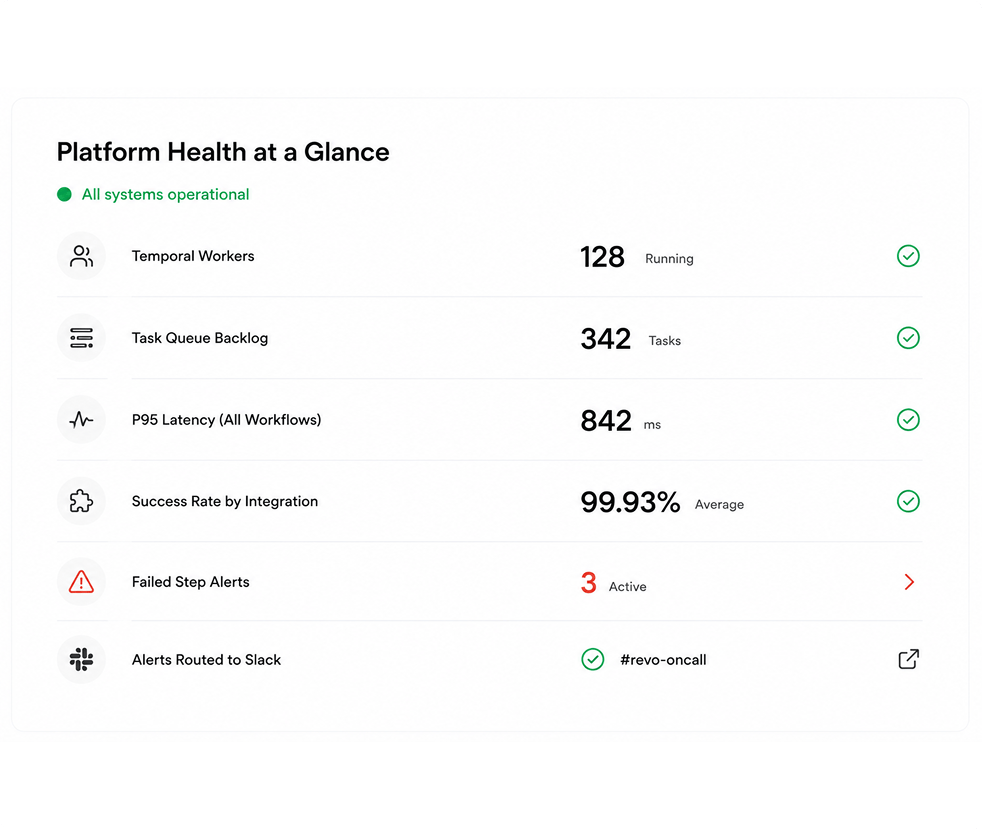
Platform health at a glance
The platform health view shows Temporal worker count, task queue backlogs, P95 latency by workflow, success rates per integration, and failed-step alerts. When something breaks, you know about it before the affected team does. Slack alerts route to the on-call.
Numbers from
platform operators.
Procurement asked for our list of integration data flows for the SOC 2 audit. I ran two SQL queries against the execution_logs table and exported the answer. The work I'd budgeted three weeks for took ninety minutes.
— Head of IT, Mid-market SaaS
0+
External apps governable
0
Native WorksBuddy app integrations
0
Condition operators in branching
0.0%
Workflow execution success rate
Centralized, federated,
or somewhere in between.

Centralized IT
Your team owns all workflows. Teams request, you build. Revo is the standard. Governance is consistent because the platform is consistent.

Federated Automation
Departments build their own workflows. You set the guardrails — which connectors are approved, who can access secrets, what data can flow. Revo enforces.

Compliance-Bound Industries
Financial services, healthcare, public sector. Audit chain on every execution. JWT-authenticated internal calls. HMAC-verified webhooks. Evidence built in.

Multi-Region Operations
Temporal clusters per region. Local fallback per region. Data residency by workflow. Cross-region replication for global workflows.
What IT leads ask before they bless an automation platform.
Replace ten Zapier accounts with one platform.
See Temporal-backed execution, audit-grade logging, and connector governance in a 30-minute demo.
Describe the workflow, Revo builds it across 1,000+ apps.
Write an automation in plain English and Revo connects your tools, then sends AI agents to take action while you sleep.
- 1,000+
- app integrations
- 99.9%
- workflow uptime
- 0
- lines of code to build
- 10x
- faster than manual