





Risk Alerts Dashboard That Spots
Every Project Risk Automatically
8 alert types monitored live, from overdue tasks to over budget, blocked tasks, and velocity decline, each with a severity level.
From invisible risk to named, severity-classified, actionable alert in four steps
TARO monitors 8 distinct risk signals across your workspace, classifying severity and tracking each alert until resolved.
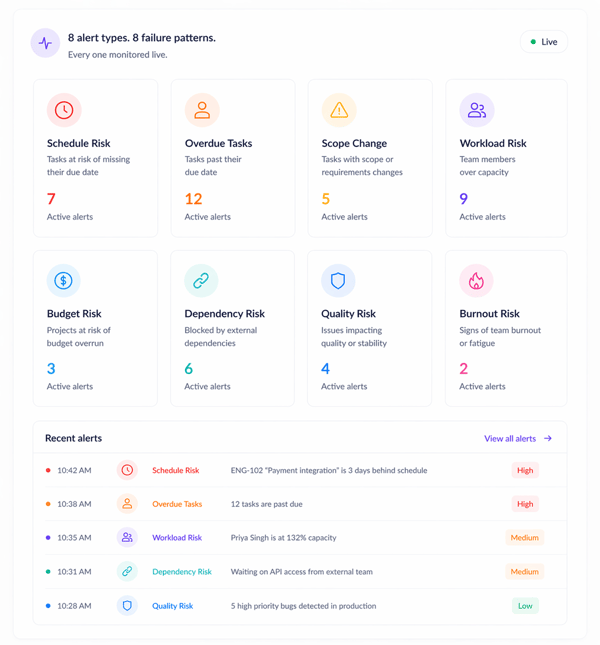
Monitor
Eight failure patterns. Every one monitored live.
TARO runs eight detection engines at once, each watching a different class of delivery risk. Every engine runs continuously. The moment a signal crosses its threshold, an alert fires, no 24-hour lag.
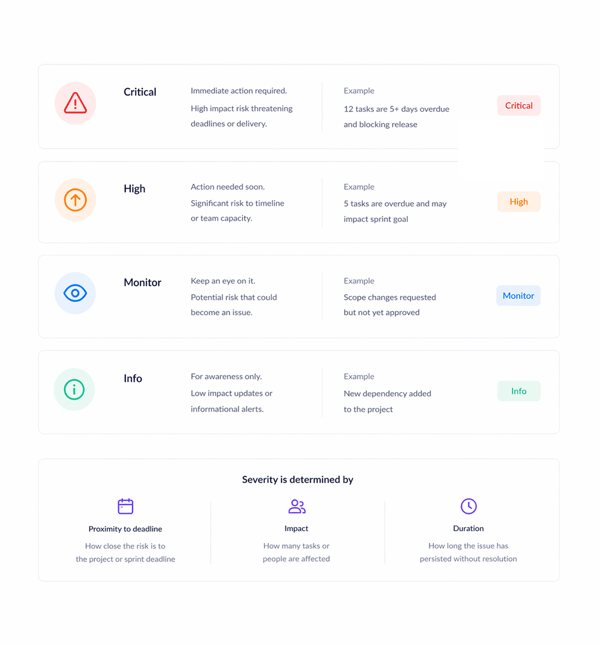
Classify
Not everything that fires is equally urgent. Severity says which is.
TARO classifies every alert into one of four severity levels: Critical, High, Monitor, and Info, based on deadline proximity, how many tasks or people are affected, and how long it has persisted.
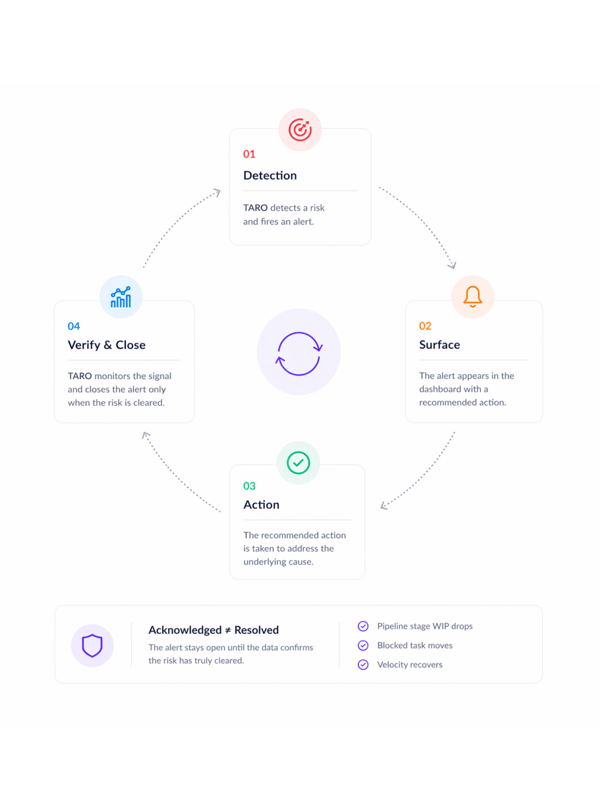
Resolve
Alerts stay open until the underlying risk actually clears.
Every alert follows a four-stage loop. Detection fires it. The dashboard surfaces it with a recommended action. The action is taken. TARO closes the alert only when the data confirms the risk has cleared.
Escalate
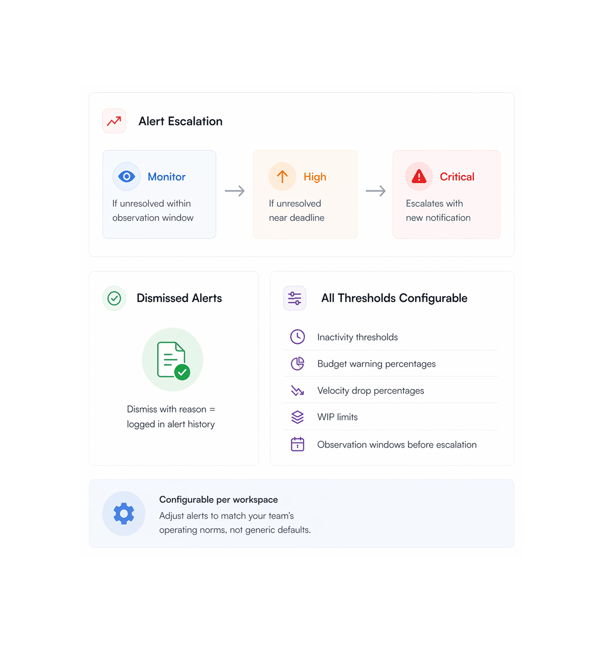
Ignored alerts escalate. Dismissed alerts are logged.
An alert left unacted on escalates. A Monitor alert not addressed within its window promotes to High. A High that persists near the deadline promotes to Critical. Escalation notifies the relevant lead.
- Monitor → High if unresolved
- High → Critical near deadline
- Dismissed (logged)
- Configurable thresholds
Six reasons teams never go back
The incident that derailed the sprint was almost always visible days earlier in a metric nobody watched. TARO watches all of them.

Eight risk types mean every failure mode is covered
Overdue tasks, deadline risk, bottlenecks, inactive projects, over budget, unassigned tasks, blocked tasks, and velocity decline, every risk class.
Severity levels prevent alert fatigue
When everything is urgent, nothing is. Four severity levels give a triage frame: Critical now, High by end of day, Monitor at standup, Info later.

Auto escalation means no risk stays invisible
An unaddressed Monitor escalates to High; an unaddressed High near deadline escalates to Critical. The chain keeps deprioritised risks alive.

Alerts close on data, not on acknowledgement
TARO won't let teams click resolved while it persists. A WIP alert closes when the count drops; a blocked-task alert closes when status changes.

All thresholds configurable to your team's norms
A velocity drop alarming for one team is routine for another. Every threshold — inactivity days, budget percentage, WIP limits, escalation windows — is configurable.

Alert history enables pattern-level retrospectives
Every alert fired, dismissed, or resolved is logged with timestamp, severity, and resolution path. Retrospectives can review which types fire most and whether risks recur.
Eight risk types mean every failure mode is covered
Overdue tasks, deadline risk, bottlenecks, inactive projects, over budget, unassigned tasks, blocked tasks, and velocity decline, every risk class.
Severity levels prevent alert fatigue
When everything is urgent, nothing is. Four severity levels give a triage frame: Critical now, High by end of day, Monitor at standup, Info later.
Auto escalation means no risk stays invisible
An unaddressed Monitor escalates to High; an unaddressed High near deadline escalates to Critical. The chain keeps deprioritised risks alive.
Alerts close on data, not on acknowledgement
TARO won't let teams click resolved while it persists. A WIP alert closes when the count drops; a blocked-task alert closes when status changes.
All thresholds configurable to your team's norms
A velocity drop alarming for one team is routine for another. Every threshold — inactivity days, budget percentage, WIP limits, escalation windows — is configurable.
Alert history enables pattern-level retrospectives
Every alert fired, dismissed, or resolved is logged with timestamp, severity, and resolution path. Retrospectives can review which types fire most and whether risks recur.




800+
trusted teams
Built for every lead who needs
warning before the miss
Leads, PMs, scrum masters, and org admins all use the Risk Alerts Dashboard for one reason: the incident that derails a sprint was usually visible days earlier in data nobody watched.
Alert types monitored
Severity levels
Alerts close on data
Risks that expire silently
The standup that asks what's blocked? already has the answer before anyone speaks.
Leads open the dashboard before standup. The blocked-task alert shows which task, who caused it, and how long. The velocity alert shows the drop. The WIP alert names the bottleneck.
Alerts surface the risk. These features resolve it.
When the Risk Alerts Dashboard fires, TARO's intelligence gives you the exact action to take.

Bottleneck Analysis
Diagnoses the stage overload or SPOF behind a Workflow Bottleneck alert, prescribing who to add as co-reviewer and what to redistribute.
Workload Distribution
When an Unassigned Tasks alert fires, Workload Distribution shows who has capacity and suggests exact assignments so work gets an owner.
Completion Analysis
The engine behind the Deadline Risk alert, predicting actual finish date from velocity, blockers, and sprint history.
Analytics & Dashboards
The Risk Alerts widget on the main dashboard surfaces the same live, severity-sorted feed giving every role a persistent view of the current risk picture.
Everything you need to know about the Risk Alerts Dashboard
Common questions from engineering leads, PMs, and org admins evaluating TARO's risk monitoring.
Taro plans, tracks, and flags risks before they hit.
Keep every project on track with AI that spots slippage early and tells your team what to do next.
- 87%
- on-time delivery
- 2.4x
- team throughput
- 0
- deadlines missed
- 35%
- fewer status meetings