





Turn Any Task Title into a Fully
Structured Description Instantly
Turn a one-liner into a fully structured task with context, requirements, and clarity ready for your team to execute.
From a brief description to a fully built task in four steps
TARO reads your brief, sends it to GPT 4o mini at no cost, and returns four ready-to-save outputs in one click.
Input
Write the way you think. TARO handles the structure.
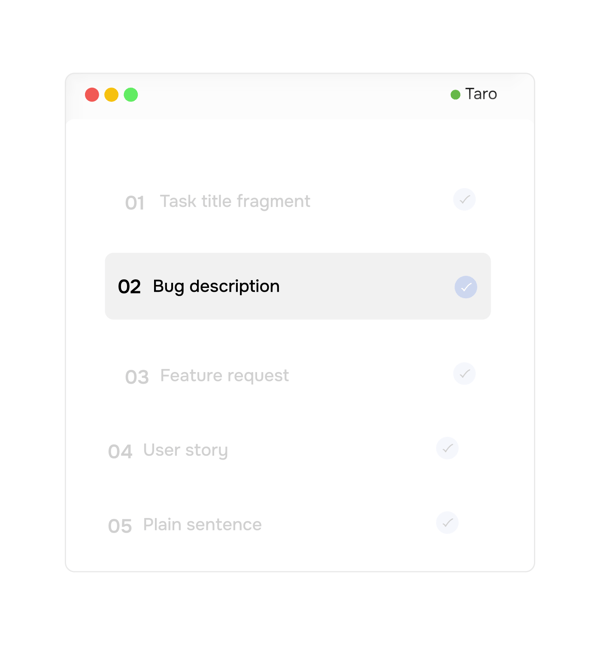
Your brief can be a rough Slack message or a detailed paragraph it doesn't matter. A title fragment, a sentence, a user story, or a bug description all work. TARO extracts intent from natural language, no format required.
Generate
Four outputs generated. Zero credits consumed.
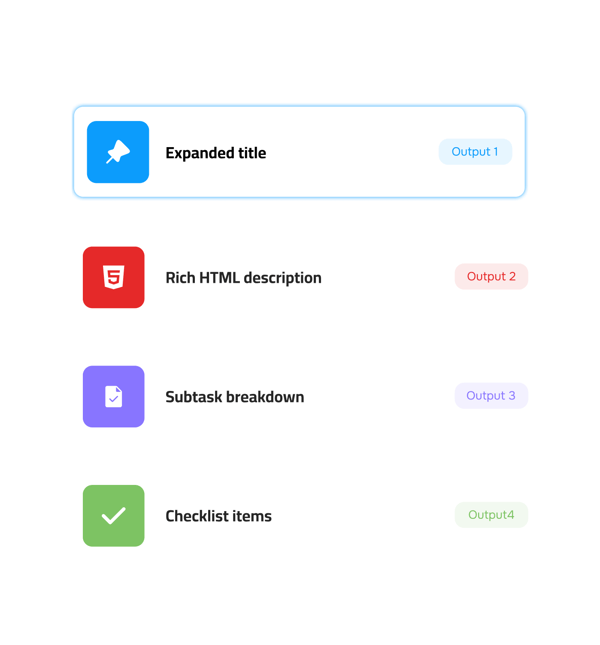
TARO sends your brief to GPT 4o mini and returns four distinct outputs at once. It runs completely free no credits deducted, no matter how often you use it. No limit on generations per day, per user, or per workspace.
Review
A complete task card. Review before you save.
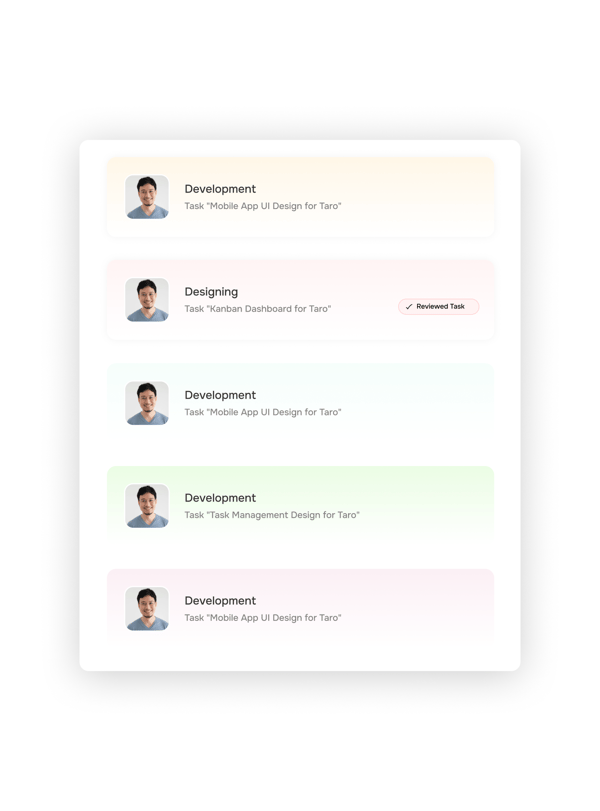
All four outputs appear in a full task preview, exactly as it'll look on your board. Title, description, subtasks, and checklist are editable, nothing commits until you save. Regenerate any section.
Save
Edit any field. Regenerate any section. Save when ready.
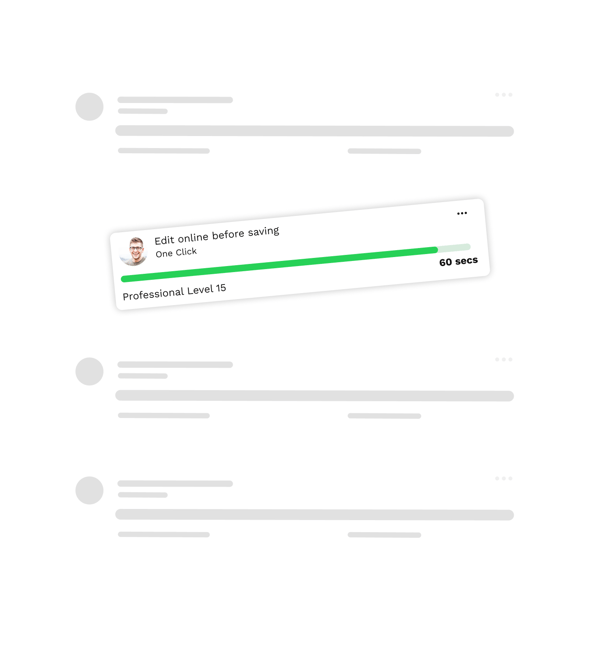
Every field is editable inline before saving click any section to edit. If the subtask breakdown doesn't fit, regenerate that section the other three stay unchanged. Save and the task lands on your board, ready to assign.
- Edit inline before saving
- Regenerate any section
- Zero credits charged
Six reasons teams never go back
Bad task descriptions derail sprints before they start. TARO makes every task thorough, clear, and ready in seconds.

Completely free no credits, no limits
Unlike other AI features in TARO, Task Detail Generation runs on GPT 4o mini at zero cost. No credits, no daily limit, no upgrade. Anyone can use it freely.

Rich HTML description, not a one liner
TARO generates a structured description with background, objective, scope, and acceptance criteria in rich HTML. The assignee opens the task and knows what done looks like.

Subtasks that reflect real implementation phases
TARO breaks the task into logical subtasks implementation phases that reflect how a developer would approach the work, each scoped to be owned independently.

Checklists that catch what everyone forgets
TARO generates checklist items covering implementation, edge cases, testing, and acceptance criteria. The questions raised in code review are there first.

Fully editable before you save
Nothing is locked after generation. Edit the title, rewrite a section, swap subtasks, add checklist items. TARO gives the first draft you decide the rest.

Regenerate any section independently
If the description is right but the subtasks aren't, regenerate just the subtasks. If the checklist misses something, regenerate it independently.
Completely free no credits, no limits
Unlike other AI features in TARO, Task Detail Generation runs on GPT 4o mini at zero cost. No credits, no daily limit, no upgrade. Anyone can use it freely.
Rich HTML description, not a one liner
TARO generates a structured description with background, objective, scope, and acceptance criteria in rich HTML. The assignee opens the task and knows what done looks like.
Subtasks that reflect real implementation phases
TARO breaks the task into logical subtasks implementation phases that reflect how a developer would approach the work, each scoped to be owned independently.
Checklists that catch what everyone forgets
TARO generates checklist items covering implementation, edge cases, testing, and acceptance criteria. The questions raised in code review are there first.
Fully editable before you save
Nothing is locked after generation. Edit the title, rewrite a section, swap subtasks, add checklist items. TARO gives the first draft you decide the rest.
Regenerate any section independently
If the description is right but the subtasks aren't, regenerate just the subtasks. If the checklist misses something, regenerate it independently.




800+
product teams, already using TARO
Built for every team where task
quality determines delivery quality
Engineers who write tasks fast, PMs who need properly scoped work items, and teams where vague tasks derail sprints all use Task Detail Generation for the same reason.
Credits consumed per generation
Outputs generated per brief
Tasks saved without edits
Faster than manual writing
Log the bug in 5 seconds. Let TARO write the full ticket.
Engineers spot issues mid-work and don't want to stop and write three paragraphs, but a thin ticket causes delays later. Task Detail Generation writes the full spec from one sentence.
Task generation is just the start
Once tasks are specified, TARO keeps them on track prioritising, distributing, predicting, and flagging.

Smart Task Creation
Type one sentence. TARO generates title, description, priority, due date, and assignee in under 3 seconds no forms, no clicks, no context switching.

Auto Prioritization
Drop your entire backlog. TARO re-orders every task with AI reasoning based on due dates, dependencies, and strategic impact no grooming meetings.

Risk Prediction
Scans for stalled workflows, velocity drops, and blocked dependencies surfacing exact action recommendations before risks become incidents.

Completion Analysis
Predicts your project's actual finish date from velocity, blockers, and sprint history. Predicted date, variance, and confidence level before you commit.
Everything you need to know about Task Detail Generation
Common questions from engineers, PMs, and team leads evaluating TARO's task generation feature.
Taro plans, tracks, and flags risks before they hit.
Keep every project on track with AI that spots slippage early and tells your team what to do next.
- 87%
- on-time delivery
- 2.4x
- team throughput
- 0
- deadlines missed
- 35%
- fewer status meetings